Sony Vario 16-70mm F/4 Aspherical Ed Za Oss Review
Designed for APS-C E-mount cameras like the Sony α6300 and α6000 and useable on total-frame Sony α cameras in crop mode, the Sony E xvi-70mm ƒ/four Carl Zeiss Vario-Tessar T* ZA OSS is a mid-range zoom with an bending of view similar to a 24-105mm on a full-frame camera.
During the 2016 Semi-Annual α Lens & Accessory Promotion the Sony Eastward 16-70mm ƒ/four Carl Zeiss Vario-Tessar T* ZA OSS has been reduced from its regular price to $899.
It's an all-purpose zoom with four aspherical and one ED glass element as well equally born Optical Steady Shot (OSS) stabilization. The 16-70mm is ideal every bit a walk-around lens for travel and street photography as well as weddings, portraits and even landscape photography. The lens is also an excellent pick for 4K shooters due to its quiet-in-lens motor.
Put only, information technology but works.
Reviewers accept come to the same determination:
"The bottom line for the Sony E-mount sixteen-70mm f/4 OSS Zeiss Lens review is I highly recommend it! Information technology totally holds upwards to the Zeiss badge and you get what you pay for in build quality, blueprint, and well-nigh importantly, performance" –SonyAlphaLab
"For Sony shooters using APS-C E-mount cameras, the Sony E 16-70mm ƒ/4 Carl Zeiss Vario-Tessar T* ZA OSS lens is a very versatile, lightweight, well-built lens with proficient epitome quality. The images are quite sharp, even wide open, and the autofocus performance is excellent." –William Brawley, Imaging-Resources
"[I]t's also a quiet performer thanks to its in-lens motor, ideal for HD motion-picture show shooting." – Mark Goldstein, PhotographyBlog
Engineering
Circular Aperture
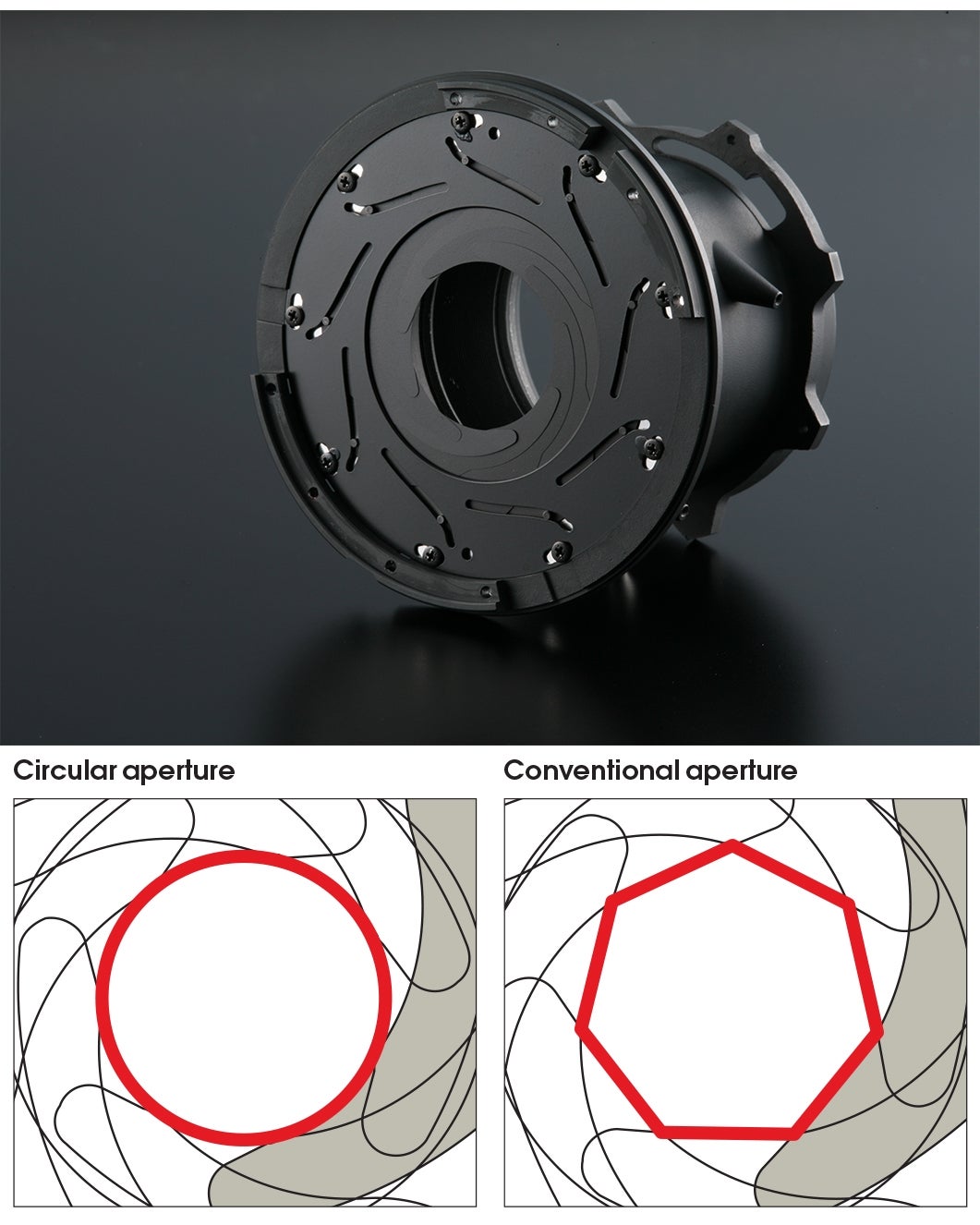
When changing your aperture to defocus the groundwork, the light sources announced blurred. This 'bokeh' effect of the blurred groundwork can be enhanced with round aperture blades used in this lens. Conventional aperture blades have flat sides creating unappealing polygonal shaped defocussed points of low-cal. α lenses overcome this problem through a unique blueprint that keeps the aperture near perfectly round from its broad-open setting to when it is closed by ii stops. Smoother, more natural defocusing tin be obtained as a consequence.
ED (Extra-low Dispersion) Glass
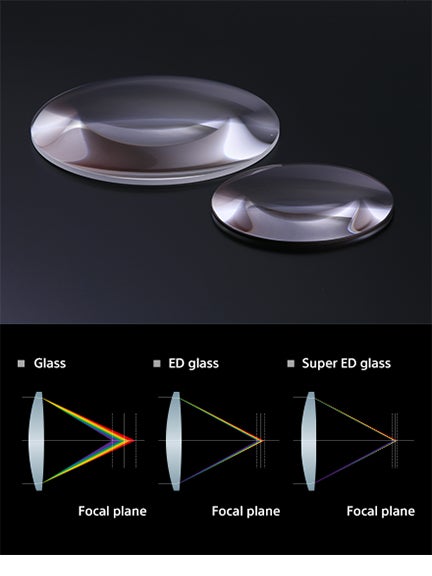
As focal lengths go longer, lenses built with conventional optical drinking glass have difficulties with chromatic aberration, and equally a outcome images suffer from lower contrast, lower color quality, and lower resolution. ED glass dramatically reduces chromatic aberration at telephoto ranges, and provides superior dissimilarity across the entire image, fifty-fifty at large aperture settings. Super ED glass provides enhanced compensation for chromatic aberration.
Aspherical Lens Elements
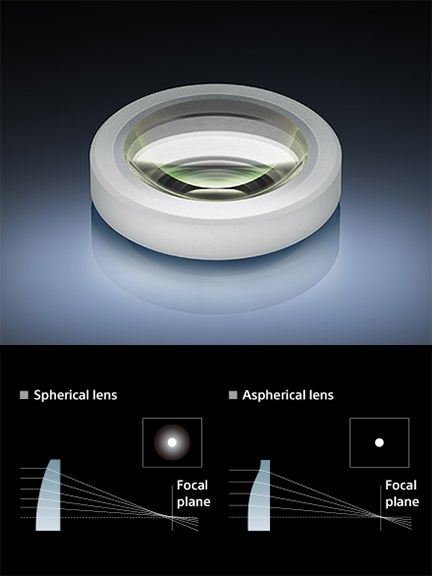
Aspherical lens design dramatically reduces spherical aberration while too reducing lens size and weight. Spherical aberration is a slight misalignment of the light rays projected on the epitome plane. This is caused by differences in refraction at different points on conventional spherical lenses which degrade image quality in large-aperture lenses. Especially shaped "aspherical" elements near the diaphragm restore alignment of calorie-free rays at the epitome plane, maintaining high sharpness and contrast even at maximum aperture and can also exist used at other points in the optical path to reduce distortion. Well-designed aspherical elements can reduce the total number of elements required in the lens, thus reducing overall size and weight.
Avant-garde Aspherical (AA) elements are an evolved variant, featuring an extremely high thickness ratio between the center and periphery. AA elements are exceedingly hard to produce, relying on the most advanced molding applied science to consistently and precisely achieve the required shape and surface accuracy, resulting in significantly improved image accuracy and quality.
Carl Zeiss T* (T-star) coating
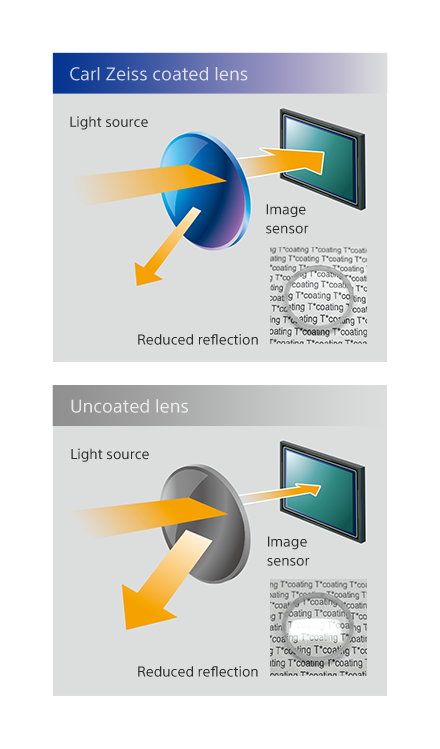
Coated optics were pioneered past Carl Zeiss - and this superb lens features the Carl Zeiss T* (T-Star) coating that almost eliminates lens flare, internal reflection and low-cal scattering that tin otherwise occur at glass-to-air surfaces. The T* coating contributes to outstanding image quality, with loftier contrast and uniformly excellent resolution right out to the image edges. Non simply applied to whatever lens - the T* symbol simply appears on multi-element lenses in which the required performance has been achieved throughout the entire optical path, therefore guaranteeing the highest quality.
Lens-Based Optical Image Stabilization (OSS)
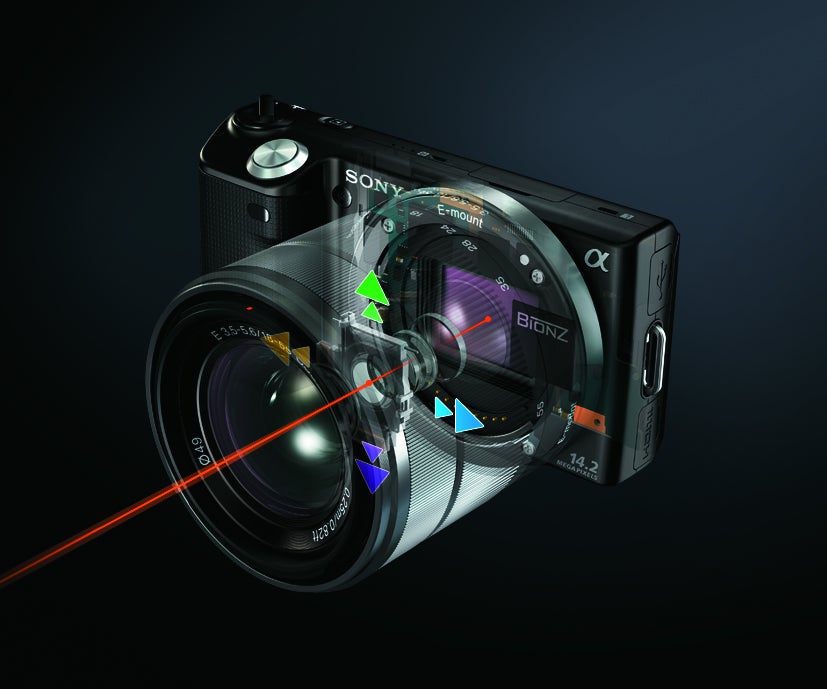
Gyro sensors built into the lens notice fifty-fifty the slightest movement, and the stabilization lens is precisely shifted to counteract any image blur that might occur. The utilize of precision, tranquility linear motors and engineering science inherited from high-stop Sony professional camcorders results in uncommonly placidity, effective image stabilization that contributes to high-quality movies as well as stills.
Internal Focusing
Only the middle groups of the optical organisation motion to achieve focus, so the overall length of the lens does not change. Other important benefits include fast autofocusing and a brusque minimum focusing altitude. Also, the filter thread at the front end of the lens does non rotate, which is convenient if you're using a polarizing filter.
Source: https://alphauniverse.com/stories/portrait-of-a-lens--sony-vario-tessar-t--e-16-70mm-f4-za-oss/
0 Response to "Sony Vario 16-70mm F/4 Aspherical Ed Za Oss Review"
Post a Comment